Bowman Warns AI Debt Nears $800 Billion: Stocks Face Correction Risk
Federal Reserve Vice Chair Michelle Bowman warned AI-related debt is on track to top $800 billion and weak returns could trigger a sharp stock correction.
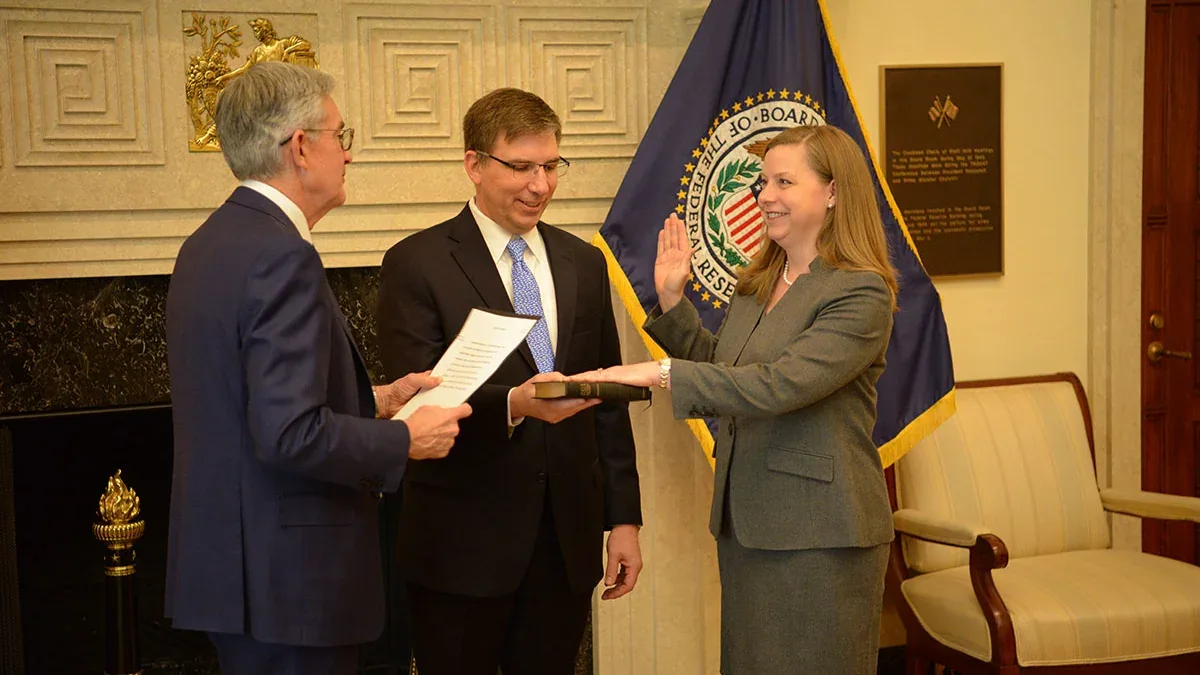
Image: Wikimedia Commons / Federalreserve
WASHINGTON, Nov. 10 — Federal Reserve Vice Chair for Supervision Michelle W. Bowman warned on Tuesday that debt tied to the artificial intelligence buildout is on track to exceed $800 billion this year, and that disappointing returns on AI investment could trigger a large correction in equity valuations. Bowman gave the warning in prepared remarks to the Council on Foreign Relations in Washington.
Bowman said AI revenues are rising quickly but do not yet cover the cost of maintaining existing models and developing new ones, or of building the data centres that power them. As capital spending has surged, hyperscalers have increasingly turned to credit and equity markets, and financing costs have risen notably.
- AI-related debt is on track to exceed $800 billion; other obligations are worth more than three times that.
- Weak AI returns could trigger a sharp correction in AI firms' shares and higher financing costs.
- Core PCE inflation likely rose to 3.3 percent in October; Bowman said there is "still work to do".
- Risks sit with a few large AI labs and hyperscalers; banks' exposure is checked in stress tests.
How Much AI Debt Is There? The $800 Billion Figure Explained
AI-related debt has been rising rapidly across corporate bonds, private credit and project finance, according to Bowman's remarks. The borrowing sits alongside a second, larger layer of commitments — long-term leases, contract promises and residual-value guarantees — whose potential payments she put at more than three times the debt, implying obligations above $2.4 trillion.
Bowman said hyperscalers and large technology firms have taken on off-balance-sheet liabilities so smaller, riskier companies can use them as collateral to fund data centres and equipment. Hyperscalers and chip designers have also taken equity stakes in smaller companies that buy their products, "creating the appearance of circular financing." Banks have already grown wary of AI debt as the market sell-off shakes lenders.
Could Weak AI Returns Trigger a Stock Market Correction?
Bowman framed the danger as a conditional risk, not a forecast. "These risks include a large correction in equity valuations, if returns on AI investment fall short of expectations, and a sharp increase in private longer-term interest rates," she said.
If AI revenues fall short of sharply rising costs, she said, the result could be a sharp correction in AI firms' share prices, higher financing costs and reduced credit access, slowing the buildout and softening activity and inflation. Some reassessment may already be under way: equity valuations have dropped in recent weeks, corporate bond spreads have widened and credit default swaps have risen for some AI-buildout companies.
What Bowman's Warning Means for Interest Rates and the December Fed Meeting
Bowman supported holding the federal funds rate at 3.75 to 4 percent at the October meeting of the Federal Open Market Committee. On inflation, she said 12-month core PCE inflation likely rose to 3.3 percent in October.
"Today, I am seeing signs that inflation pressures are persisting, while labor market conditions appear to be firming," Bowman said. "This indicates that there is still work to do to bring inflation closer to 2 percent." Governor Christopher Waller has backed a December rate rise.
| Measure | Figure | Period |
|---|---|---|
| AI-related debt | Above $800 billion | 2026 |
| Other AI obligations | Above $2.4 trillion | 2026 |
| Core PCE inflation | 3.3 percent | October 2026 |
| Federal funds rate | 3.75 to 4.00 percent | October 2026 |
Frequently Asked Questions
How much AI-related debt is there in 2026?
On track to exceed $800 billion this year, Bowman said, with other obligations worth more than three times that amount.
Did the Federal Reserve warn of a stock market correction over AI?
Bowman warned weak AI returns could trigger a large correction in equity valuations and higher financing costs. She described a conditional risk, not a forecast that a crash is certain.
What did Michelle Bowman say about interest rates?
She backed holding the federal funds rate at 3.75 to 4 percent in October. The December decision follows the October PCE report and November jobs data.
Are US banks exposed to AI debt?
Yes. The largest US bank holding companies have some exposure, examined in annual stress tests. Insurers, pension funds and mutual funds are exposed too.
The Federal Open Market Committee meets in December, when it will receive the October PCE inflation report and the November employment report before deciding whether to change interest rates.