Rubio Downplays Midterm Rout, Fuels 2028 Talk at Federalist Event
Secretary of State Marco Rubio told conservatives that 'great things that last are built in decades, not election cycles' after the GOP's midterm losses.
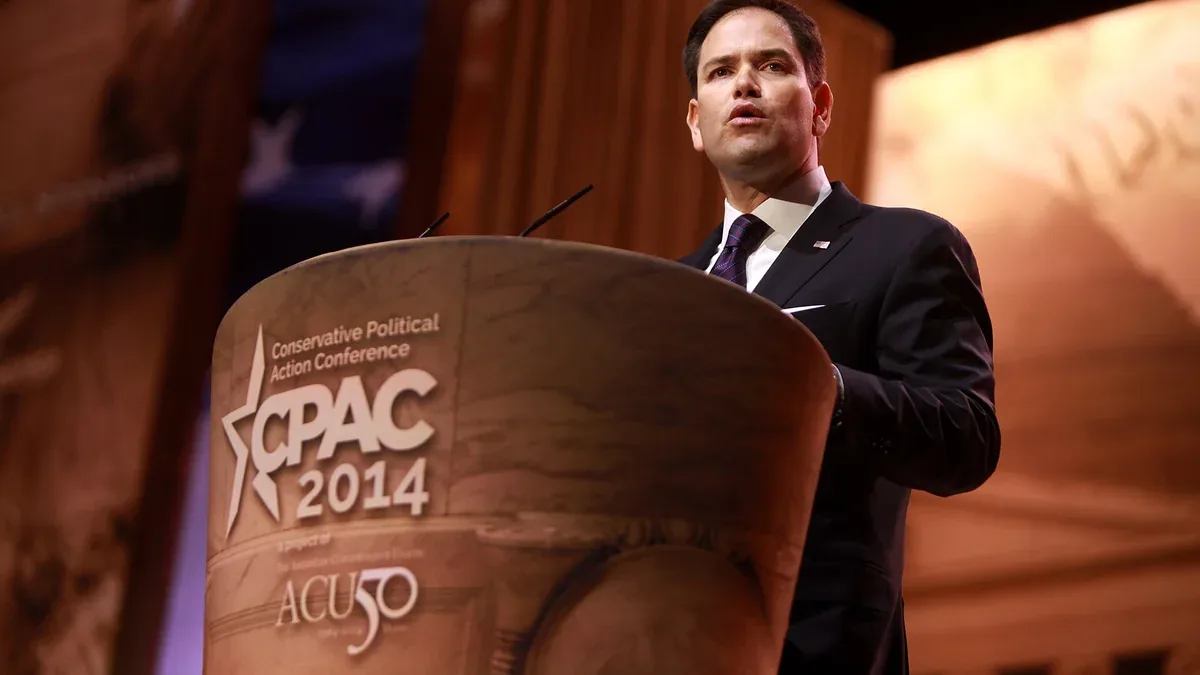
Image: Wikimedia Commons / Gage Skidmore
WASHINGTON, November 14, 2026 — Secretary of State Marco Rubio used his first major speech since the November 3 midterm elections to tell fellow conservatives that one bad election does not decide the future, as he downplayed Republican losses and fuelled fresh speculation about a 2028 presidential run.
Mr Rubio delivered the Federalist Society's Barbara K. Olson Memorial Lecture, titled "Enemies in War, in Peace Friends", at the Mayflower Hotel in Washington on Friday evening. Democrats gained more than 40 seats in the House and eight in the Senate.
Key Takeaways
- Rubio: "great things that last are built in decades, not election cycles" as Democrats gained 40-plus House seats and eight Senate seats.
- He attacked the "weaponisation of international law" and praised sanctions on the International Criminal Court.
- He declined again to discuss a 2028 run, repeating that he would not stand against Vice President JD Vance.
- He warned many families are struggling and called it "un-American" if this became the first generation to leave the next worse off.
What Rubio Said About the 2028 Presidential Race
Mr Rubio has faced mounting questions about a 2028 run, and his appearance did little to settle them. He told the audience: "We have much more to do over the next two, the next six, the next 20 years. Great things that last are built in decades, not election cycles." The line drew a standing ovation.
He compared disheartened conservatives with the Revolutionary Army of December 1776. "Five years later, Washington surrounded the British army at Yorktown. Cornwallis surrendered. The revolution prevailed, and a nation was born," he said. Mr Rubio has declined in recent days to discuss 2028 "in any form or fashion". Reports last week said he is contemplating resigning to run, but he has also said he would not oppose Mr Vance should the vice president choose to run.
| Measure | Result | What it means |
|---|---|---|
| Democratic gains, House | More than 40 seats | Democrats take control |
| Democratic gains, Senate | Eight seats | Democrats take control |
| Rubio lecture | 25th Barbara K. Olson Memorial Lecture | First speech since the midterms |
Why Rubio Attacked the International Criminal Court
The prepared speech was harder-edged than the unscripted question-and-answer session. Mr Rubio lashed out at the "weaponisation of international law" and at "activist courts who seek to govern by injunction", drawing applause when he highlighted sanctions on the International Criminal Court. The United States signed but never ratified the Rome Statute that created the court, and the administration has sanctioned its prosecutors and judges.
Mr Rubio warned the court against trying to prosecute Americans, signalling a firmer posture that may push planned sanctions forward. He also answered a remark from Representative Robert Garcia, the incoming House Oversight Committee chairman.
How Rubio Addressed Voters' Economic Anxiety After the Midterms
Mr Rubio also spoke to the economic anxiety that shaped the midterm result. "I think we have to recognise that people are struggling," he said. He warned of a "legitimate fear" that this could be the first generation to leave the next worse off, which he called "un-American".
The passage was aimed at bridging the divide between old-school Reagan-era conservatism and the president's populist coalition. The leadership contests now under way in the new Democratic majorities will set the terms: Senator Chris Van Hollen has already challenged Chuck Schumer for the Senate leadership, while Mr Rubio's diplomacy continues, including his call with China's foreign minister on trilateral denuclearisation.
Frequently Asked Questions
Is Marco Rubio running for president in 2028?
Mr Rubio has not announced a 2028 campaign and has declined to discuss the race. Reports said he may resign to run, but he would not oppose Vice President JD Vance.
What did Marco Rubio say at the Federalist Society?
He told conservatives that "great things that last are built in decades, not election cycles". He attacked the weaponisation of international law and praised sanctions on the court.
How many seats did Democrats win in the 2026 midterms?
Democrats gained more than 40 seats in the House and eight in the Senate. The new majorities take office in January 2027.
Why did Rubio criticise the International Criminal Court?
Mr Rubio accused the court of seeking to weaken the United States through law. The United States signed but never ratified the Rome Statute, and the administration has sanctioned its prosecutors and judges.
The Federalist Society convention continues through Saturday, and Mr Rubio has given no date for any decision about 2028.