FDA Clears Mediwhale Retinal AI to Predict Heart Risk in 10 Years
The FDA has cleared Mediwhale's Dr. Noon CVD, AI software that reads a retinal photo to estimate 10-year heart disease risk for adults aged 45 to 79.
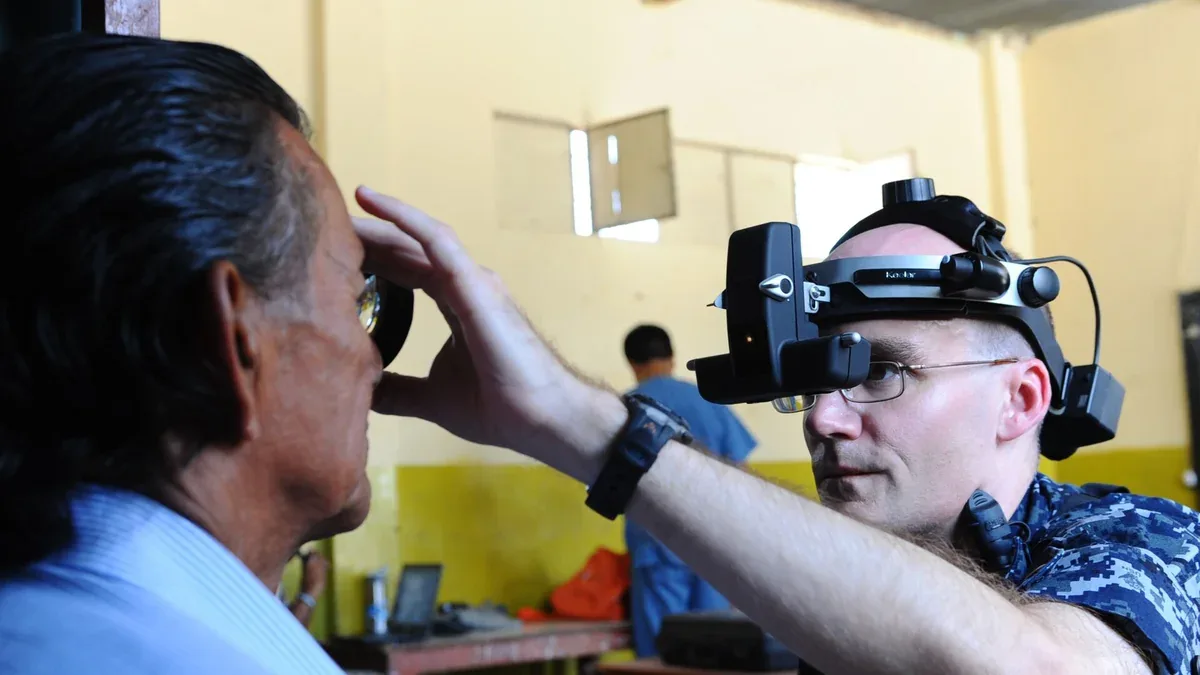
Image: Wikimedia Commons / U.S. Air Force photo by Senior Airman Kasey Close
The U.S. Food and Drug Administration has granted 510(k) clearance to Dr. Noon CVD, software from South Korea's Mediwhale that uses artificial intelligence to estimate a person's risk of a first heart attack or stroke over 10 years from a photograph of the retina, the company said on Friday, November 27.
The software combines AI analysis of retinal images with a person's age and sex to place patients in one of three risk categories to support a clinician's cardiovascular assessment. It is intended for adults aged 45 to 79 who have not been diagnosed with atherosclerotic cardiovascular disease.
Key Takeaways
- The FDA granted 510(k) clearance on November 27 for Mediwhale's Dr. Noon CVD, the company's first clearance from the agency.
- The software estimates the 10-year risk of a first heart attack or stroke from a retinal image, age and sex.
- Mediwhale aims it at U.S. primary care, where retinal cameras are already used daily for diabetic eye exams.
- No accuracy figures, pricing, U.S. partners or launch date have been disclosed.
| Detail | Dr. Noon CVD |
|---|---|
| Developer | Mediwhale, Seoul, South Korea |
| Clearance | FDA 510(k), November 27, 2026 |
| Inputs | Retinal image, age, sex |
| Output | 10-year risk of a first cardiovascular event |
| Intended users | Adults 45 to 79 with no prior cardiovascular disease |
| First market | South Korea, approved and reimbursed |
How Does Mediwhale's Retinal AI Estimate Heart Disease Risk?
The blood vessels at the back of the eye mirror the state of vessels elsewhere in the body, and Mediwhale's software reads patterns in a retinal photograph that are linked to cardiovascular risk. That analysis, combined with the patient's age and sex, produces a 10-year risk estimate for a first atherosclerotic cardiovascular disease event in one of three categories.
The software does not diagnose heart disease. Its clearance covers risk assessment, supporting a clinician's judgment alongside blood pressure, cholesterol and medical history. A 510(k) clearance means the FDA found the software substantially equivalent to a device already on the market, a faster route than full premarket approval.
Who Can Use Dr. Noon CVD and Where Will It Be Available?
It is intended for adults aged 45 to 79 with no history of atherosclerotic cardiovascular disease, a group in which a 10-year risk estimate can change prevention decisions. Mediwhale plans to bring it to U.S. primary care through retinal imaging networks already in clinics, where cameras screen daily for diabetic eye disease.
"Retinal cameras are already in primary care clinics across the United States, where they are used every day for diabetic eye exams," said Kevin Taegeun Choi, chief executive of Mediwhale. "With FDA clearance, that same retinal exam can now do more: support cardiovascular risk assessment."
In South Korea, Dr. Noon CVD is already commercial, with approval and reimbursement. It has not named U.S. partners or given a date for the first deployments. The FDA has also approved Sunharbo, a first-in-class Factor XIa inhibitor to prevent stroke, and ordered a vision-loss warning on GLP-1 weight-loss drugs.
What the FDA Clearance Does Not Mean for Patients
Clearance is not proof the software will perform well in American clinics. Mediwhale has published no accuracy figures, and its announcement gives no pricing, reimbursement terms, U.S. partners or launch timetable. The company says it will build U.S. real-world data as the software reaches clinics.
For now, the clearance gives Mediwhale its first foothold in the United States.
Frequently Asked Questions
Can an eye scan really predict heart attack risk?
An eye scan cannot predict a heart attack on its own. The retina's blood vessels reflect vascular health elsewhere in the body, and the software uses patterns in a retinal photograph, with age and sex, to estimate 10-year risk — an aid for clinicians, not a diagnosis.
Is Dr. Noon CVD available in U.S. clinics now?
Not yet. The FDA clearance, announced on November 27, paves the way for Mediwhale to introduce the software into U.S. clinical practice. The company says it will work with partners operating retinal imaging networks in primary care but has announced no launch date.
How accurate is Mediwhale's retinal AI heart risk test?
Mediwhale has not published accuracy figures for Dr. Noon CVD, such as sensitivity or specificity. The clearance rests on the software being substantially equivalent to a device already on the market; independent evidence of its U.S. performance is still to come.
Mediwhale has given no date for the first U.S. deployments nor named its partners. The next step to watch is the first U.S. rollout.