Voyager 1 Reaches One Light-Day From Earth: What It Means
NASA's Voyager 1 crossed one light-day from Earth on 18 November, 16.1 billion miles out, where a radio signal now takes a full day to arrive.
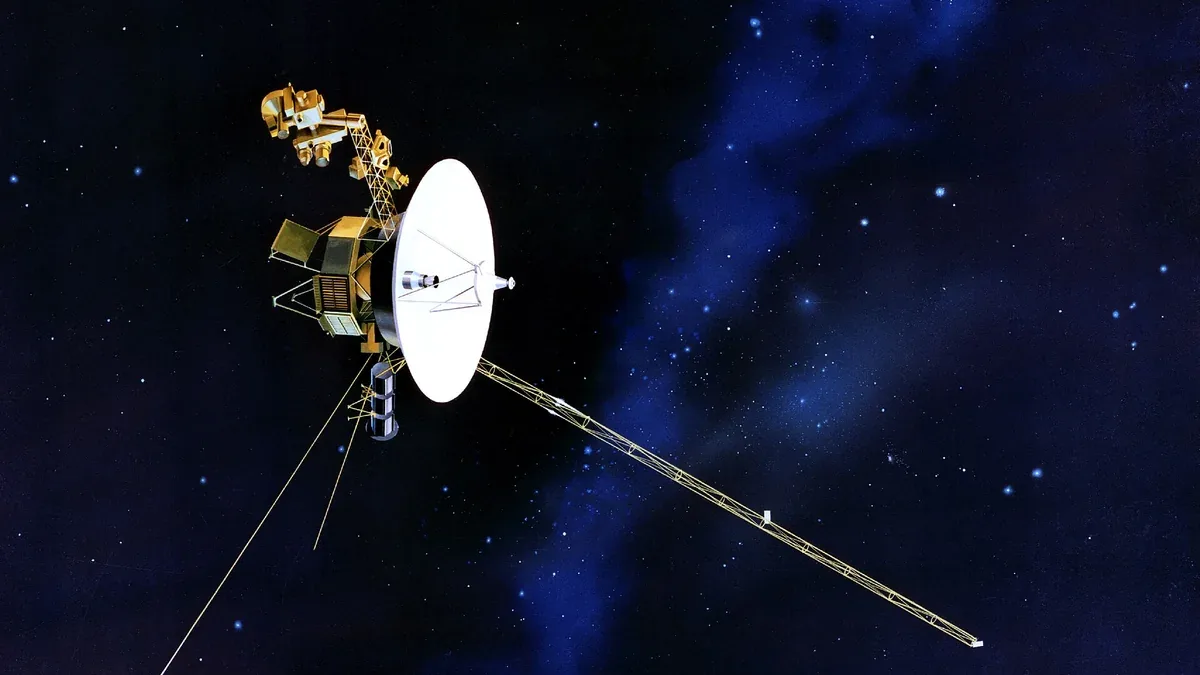
Image: Wikimedia Commons / NASA/JPL
WASHINGTON, November 18, 2026 — NASA's Voyager 1 spacecraft crossed a distance of one light-day from Earth at 5:16:07 a.m. EST on Wednesday, becoming the first human-made object to travel so far that light itself needs a full day to reach it. Launched from Cape Canaveral on September 5, 1977, it is now about 16.1 billion miles (25.9 billion kilometres) away, still returning data from interstellar space.
A light-day is the distance light covers in 24 hours. Sunlight takes just over eight minutes to reach Earth, but a radio command now needs 24 hours to reach Voyager 1, and any reply takes another 24 hours to return.
Key Takeaways
- Voyager 1 reached one light-day — 16.1 billion miles out — at 5:16:07 a.m. EST on November 18, 2026, after 49 years, two months and 11 days.
- Radio signals take 24 hours each way, so a command and its reply span 48 hours.
- Voyager 1 has been the most distant human-made object since passing Pioneer 10 in 1998, and the first to cross the heliopause, in August 2012.
- Its twin, Voyager 2, is 13.5 billion miles out and will not reach one light-day until November 2035.
What Is a Light-Day and How Far Is Voyager 1 From Earth?
A light-day measures distance, not time in flight: it is the distance light travels in 24 hours — 25,902,068,356 kilometres, or 16,094,799,096 miles. Voyager 1 has taken 49 years to cover it, at about 37,800 miles per hour.
Voyager 1 took the shorter route, after flybys of Jupiter in 1979 and Saturn in 1980. Voyager 2, launched two weeks earlier, toured Uranus and Neptune too, and now trails by about 2.6 billion miles.
| Voyager 1 | Voyager 2 | |
|---|---|---|
| Launch date | September 5, 1977 | August 20, 1977 |
| Distance from Earth | 16.1 billion miles (25.9 billion km) | 13.5 billion miles (21.7 billion km) |
| Crossed the heliopause | August 2012 | November 2018 |
| Reaches one light-day | November 18, 2026 | November 2035 |
How NASA Still Talks to Voyager 1 After 49 Years
The two Voyagers are the only spacecraft to venture beyond the heliosphere, the bubble of charged particles and magnetic fields created by the Sun. Both remain scientifically active, and NASA expects Voyager 1 to keep operating for a few more years.
The distance shapes every decision: a fault that would take minutes to diagnose near Earth needs two full days of waiting with Voyager 1. "I think it's very exciting because it's a tangible distance that people can relate to," Jamie Rankin, the mission's deputy project scientist at Princeton University, said in NASA's Curious Universe podcast. NASA asked the public to flash the spacecraft's call sign, V-G-R, in Morse code on Tuesday evening.
Where Is Voyager 1 Headed Next?
Voyager 1 is heading for the star Gliese 445, more than 17 light-years away, and NASA estimates it will pass within about 1.7 light-years of it in around 40,000 years. On board it carries the Golden Record, a 12-inch gold-plated copper disc holding sounds and images of Earth.
The mission turns 50 in 2027, when a Voyager documentary debuts on NASA+. Before that, NASA hosts a discussion at the Jet Propulsion Laboratory on Thursday, November 19, at noon ET, streamed live on NASA's YouTube channel. More detail is on NASA's Voyager mission pages. Flight closer to home has quickened too — SpaceX's Starship Flight 15 lifted off this week with a double catch, while SpaceX is building $74 billion of AI supercomputing campuses in Texas and Arizona — but nothing built by humans has travelled as far as Voyager 1.
Frequently Asked Questions
How far is one light-day in miles?
One light-day is about 16.1 billion miles (25.9 billion kilometres), the distance light travels in 24 hours.
How long does a signal take to reach Voyager 1?
A radio signal takes 24 hours to reach Voyager 1, and a reply takes another 24 hours to return — a 48-hour round trip.
When will Voyager 2 reach one light-day from Earth?
Voyager 2 is about 13.5 billion miles out and should reach one light-day in November 2035, about nine years after its twin.
What is the Golden Record carried by Voyager 1?
The Golden Record is a 12-inch gold-plated copper disc on Voyager 1 carrying sounds and images of Earth for any civilisation that might find it.
NASA has not yet said when Voyager 1's instruments will fall silent, but the Jet Propulsion Laboratory discussion on November 19 will give the next public update on both Voyagers.